
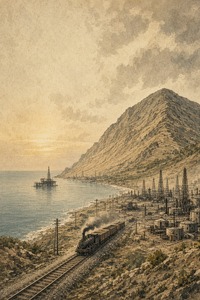
How Izberbash appeared: the beginning of the story
The history of Izberbash is not limited to one date or monument. This is a small seaside town at the foot of the Pushkin-Tau mountain, where geography, roads, labor and social life changed the face of the place. The topic of the article is the origin of the settlement; it helps to look at the modern city more carefully.
It is better to build a historical route from verifiable facts to the urban environment. Please check the exact museum hours and access to monuments before your trip. DimPoisk will help you find a cafe, hotel, taxi and other organizations nearby, but historical dates should be checked with museums and official directories.
Short historical line
- Modern Izberbash grew up in the 20th century next to the railway and oil fields.
- The workers' village of Izberbash was founded in 1932.
- On June 1, 1950, Izberbash received city status.
- The industrial history here is adjacent to the resort role of the Caspian coast.
These facts explain why Izberbash looks the way it does. Some layers are visible in the layout and names, others in the professions of residents, family memories and the direction of main roads. It is important to distinguish between documented history and popular legends: both are interesting, but they need to be labeled differently.
What to read in a modern city
Start from the point “city beach and the shore of the Caspian Sea”, then pay attention to the “seaside walking streets”. The third stop is “Mount Pushkin-Tau and its silhouette.” This order links the overall narrative to observable details: the material of the walls, the topography, the scale of the neighborhoods, and the way the city faces the sea, the plain, or the foothills.
Not every old building has museum status, and new does not mean devoid of history. Soviet buildings, an industrial facility, a park or a market also tell of a time when the city was growing and receiving new functions.
Pushkin-tau and oil history: main story
For the topic “origin of the settlement,” the key reference point is Pushkin-Tau and oil history. Think of it not as a stand-alone backdrop for a photograph, but as part of a system of roads, settlements and activities. Before visiting, check the official shooting hours and rules.
A good historical question is specific: who built it and why, how the place was connected to neighboring areas, why it was preserved or changed. In Izberbash, the answers often lie at the intersection of local tradition and the overall Russian history of the Caucasus.
Route for several hours
- The beginning is the city beach and the shore of the Caspian Sea: general context and orientation.
- Continuation - seaside walking streets: details of the urban environment.
- The finale is Mount Pushkin-Tau and its silhouette: a modern look at the past.
- After the route, there’s a museum, a library, or a quiet cafe for taking notes.
Allow at least three hours for the walk. In October and November, historical sites are best viewed in daylight, leaving the evening for indoors. If part of the route is closed, do not seek a detour through private or business property.
Museums, documents and family memories
The museum exhibition gives a chronology, but the story is supplemented by old photographs, street names, family memories and everyday objects. It is useful to record an oral history with the permission of the interlocutor, indicating that this is a person’s memory, and not an archival document.
Before your trip, find the official phone number of the cultural institution in Izberbash and check the hours. If the organization's card is in DimPoisk, compare the information with the official source: catalogs help with contacts and routes, and the museum is responsible for content and schedule.
How DimPoisk helps the historical walk
History sets the route, and the catalog resolves practical issues around it. Select Izberbash, find a hotel, cafe, taxi, pharmacy or store near the desired part of the city. See address, opening hours, phone number, entrance photos and latest reviews.
- Keep organizations along the way, not at the opposite end of town.
- Check if the place is open on the selected day.
- For groups, please confirm reservations and parking in advance.
- Do not replace the historical source with an advertising description of the card.
Ethics of historical tourism
Monuments, cemeteries, religious buildings and memorials require discreet behavior. Do not stage staged filming where people are praying or remembering loved ones. Archaeological fragments must not be taken, moved or used as support.
On Pushkin-Tau, choose the official accessible route, take into account the wind and do not go out onto the slope at dusk. This rule applies not only to safety, but also to saving space. The best way to support cultural heritage is to use official routes, guided tours and local organizations with clear contacts.
What to remember
The history of Izberbash becomes clearer when the date is associated with a specific place, and the monument is associated with the lives of people. Keep the three anchor points, one verified museum contact, and the DimPoisk practice cards nearby. This way, the historical walk will remain meaningful and at the same time comfortable.
If the topic interests you, compare the museum text, local history publication and map. Different sources may date different stages of the history of Izberbash differently; It is better to keep the wording neat in the article.
Take a notepad or save a note in your phone: names, dates and questions are quickly forgotten. After the walk, separate confirmed information from heard legends - this way the material will remain honest.